Proposition (held fixed): When will Tesla’s in-house 4680 cell, shown at Battery Day 2020, reach high volume and deliver its cost reduction? The $25,000 car is on its own page.
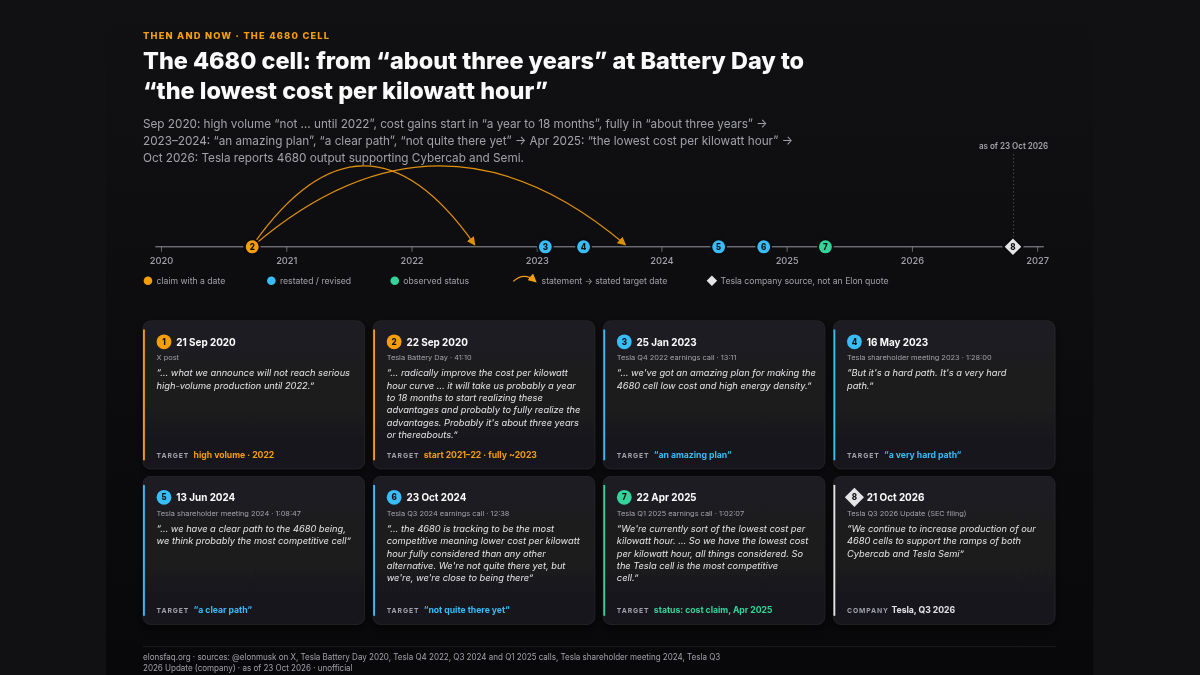
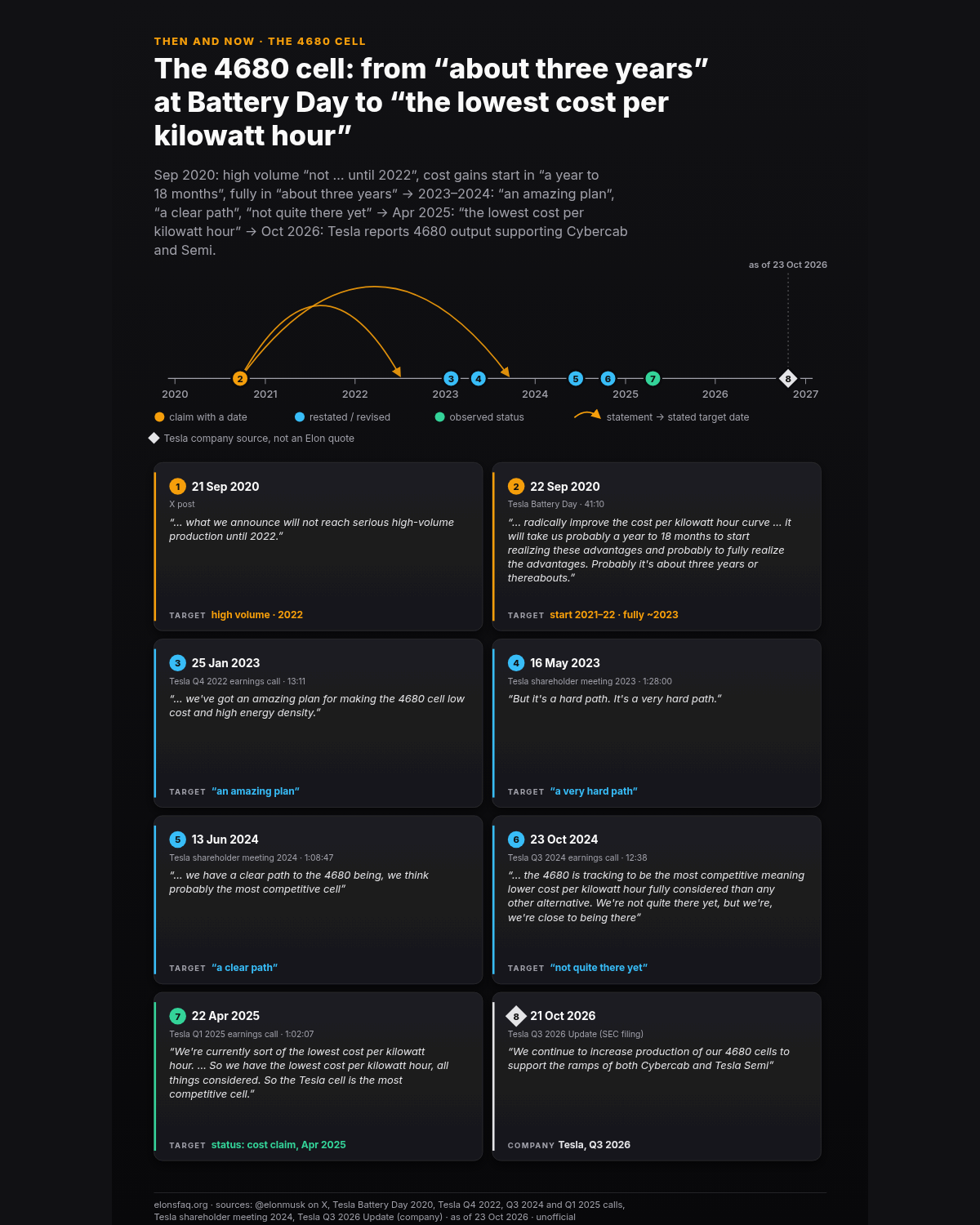
~2023Battery Day “about three years”
Oct 2024“not quite there yet”
Apr 2025“the lowest cost per kilowatt hour”
Then vs now · Battery Day and the 4680
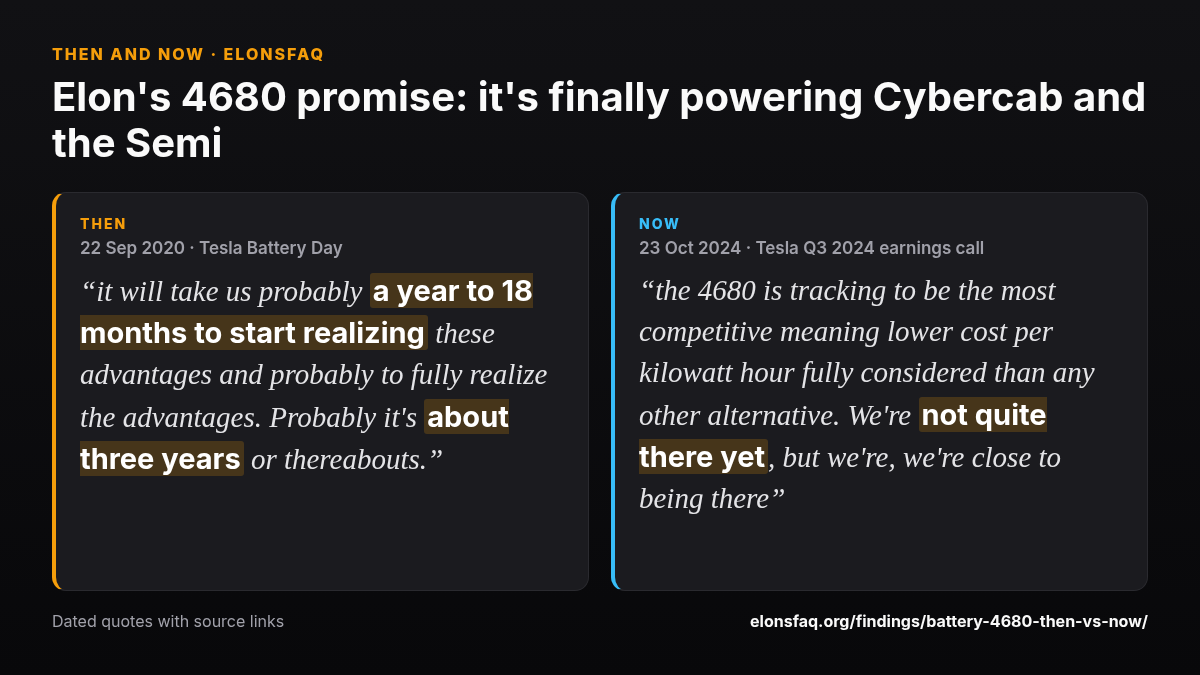
From “about three years” to “not quite there yet”, four years after Battery Day.
“it will take us probably a year to 18 months to start realizing these advantages and probably to fully realize the advantages. Probably it's about three years or thereabouts.”
“the 4680 is tracking to be the most competitive meaning lower cost per kilowatt hour fully considered than any other alternative. We're not quite there yet, but we're, we're close to being there”
What did not change: cost per kilowatt hour as the key number · the 4680 as Tesla’s in-house cell. ElonsFAQ corpus · verified 2026-10-23 · unofficial archive.
21 September 2020, on X, the day before Battery Day:
“This affects long-term production, especially Semi, Cybertruck & Roadster, but what we announce will not reach serious high-volume production until 2022.”
“it will take us probably a year to 18 months to start realizing these advantages and probably to fully realize the advantages. Probably it's about three years or thereabouts.”
“the 4680 is tracking to be the most competitive meaning lower cost per kilowatt hour fully considered than any other alternative. We're not quite there yet, but we're, we're close to being there”
This is Musk’s own cost claim; this page cites no independent cost figure.
In use for years, but volume came slowly
Company figures, not Elon quotes. Q4 2022: the 4680 team reached about 1,000 cars a week of cells in Texas, with one of four lines in production (Tesla Q4 2022 call, 25 Jan 2023, video). Q2 2024: more than 1,400 Cybertrucks a week of 4680 cells (Tesla Q2 2024 call, video). Oct 2026: Texas has more than 40 GWh a year of installed 4680 capacity, which now supports the Cybercab and Tesla Semi ramps, while battery supply still limits vehicle production (Tesla Q3 2026 Update).
Elon: harder than expected
16 May 2023, shareholder meeting:
“we do see a path to very high energy density and higher energy density and lower cost than anything else out there. But it's a hard path. It's a very hard path. And normally it would be absurd for companies to attempt such a thing.”
“we're also innovating a lot in battery production with the 4680 that's built right here. And it is, it's a hard problem. … Like all the cybertrucks that you see use the Tesla 4680 cell.”
What Tesla (the company) says in its own filings. These are company statements, not Elon Musk quotes, and are not counted in the then-and-now comparison above.
Company source · not an Elon Musk quote “We continue to increase production of our 4680 cells to support the ramps of both Cybercab and Tesla Semi along with higher Model Y volumes.”
start in “a year to 18 months”; fully in “about three years or thereabouts”
“not quite there yet” (Oct 2024); “the lowest cost per kilowatt hour” (Apr 2025)
What did not change
The metric: cost per kilowatt hour.
The cell: the 4680, made in-house.
Neutral conclusion
At Battery Day (Sep 2020) Musk said the cost advantages would start in about a year to 18 months and be fully realized in about three years, i.e. around 2023; the day before, he said what was announced would not reach serious high-volume production until 2022. In Oct 2024 he said the 4680 was “not quite there yet” on cost; in Apr 2025 he said Tesla has the lowest cost per kilowatt hour. In Oct 2026 Tesla’s own update says 4680 production is increasing to support Cybercab and Tesla Semi. This compares dated wording; it makes no claim about motives.
Scope
Indexed ElonsFAQ corpus (transcripts and X posts); not every Musk interview.
YouTube wording is from automatic captions (ASR); fillers such as “uh” are kept as spoken.
Calendar readings of relative dates (next year, this year) use the statement date.
Latest from Tesla items are company statements, not Elon Musk quotes.