Proposition (held fixed): When will the first uncrewed Starships launch from Earth toward Mars? Same vehicle, no people on board (Optimus still counts as uncrewed of humans), same destination, next Earth–Mars transfer window. Full reuse and ship catch are on the Starship timelines page.
Nov/Dec 2026named as “the default plan” (Feb 2025)
“Slight chance”same window, Aug 2025
a few years soonerMars lander vs people in 5–7 years (Jul 2026)
Then vs now · Uncrewed Starship to Mars
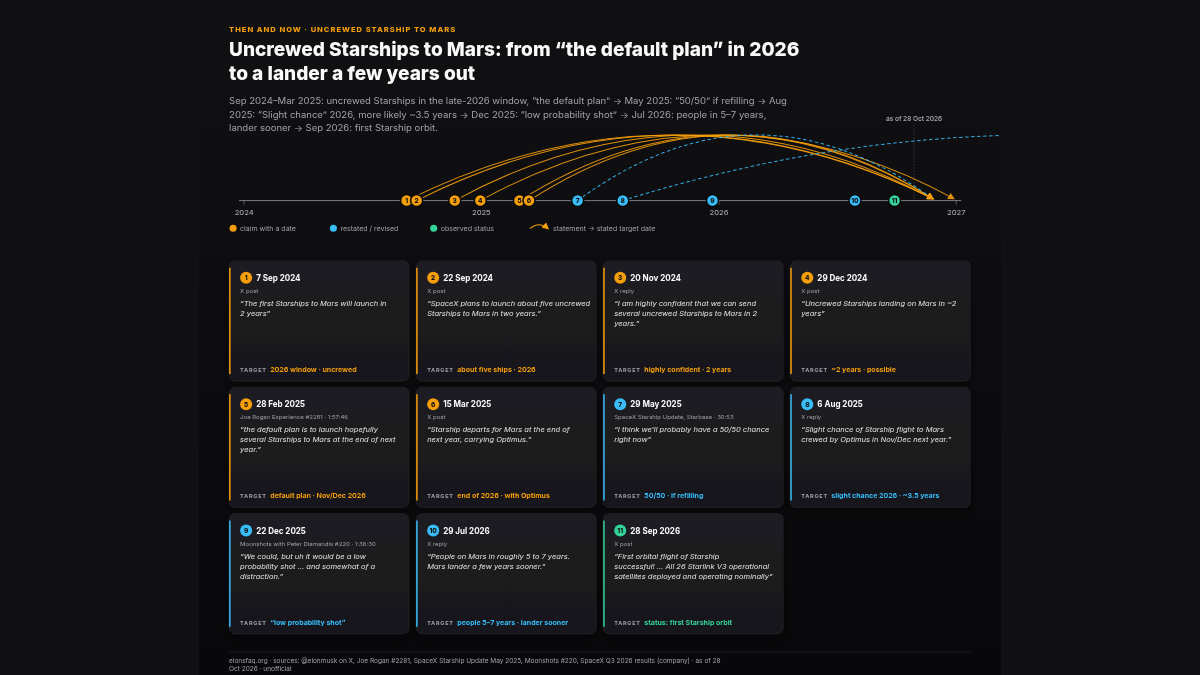
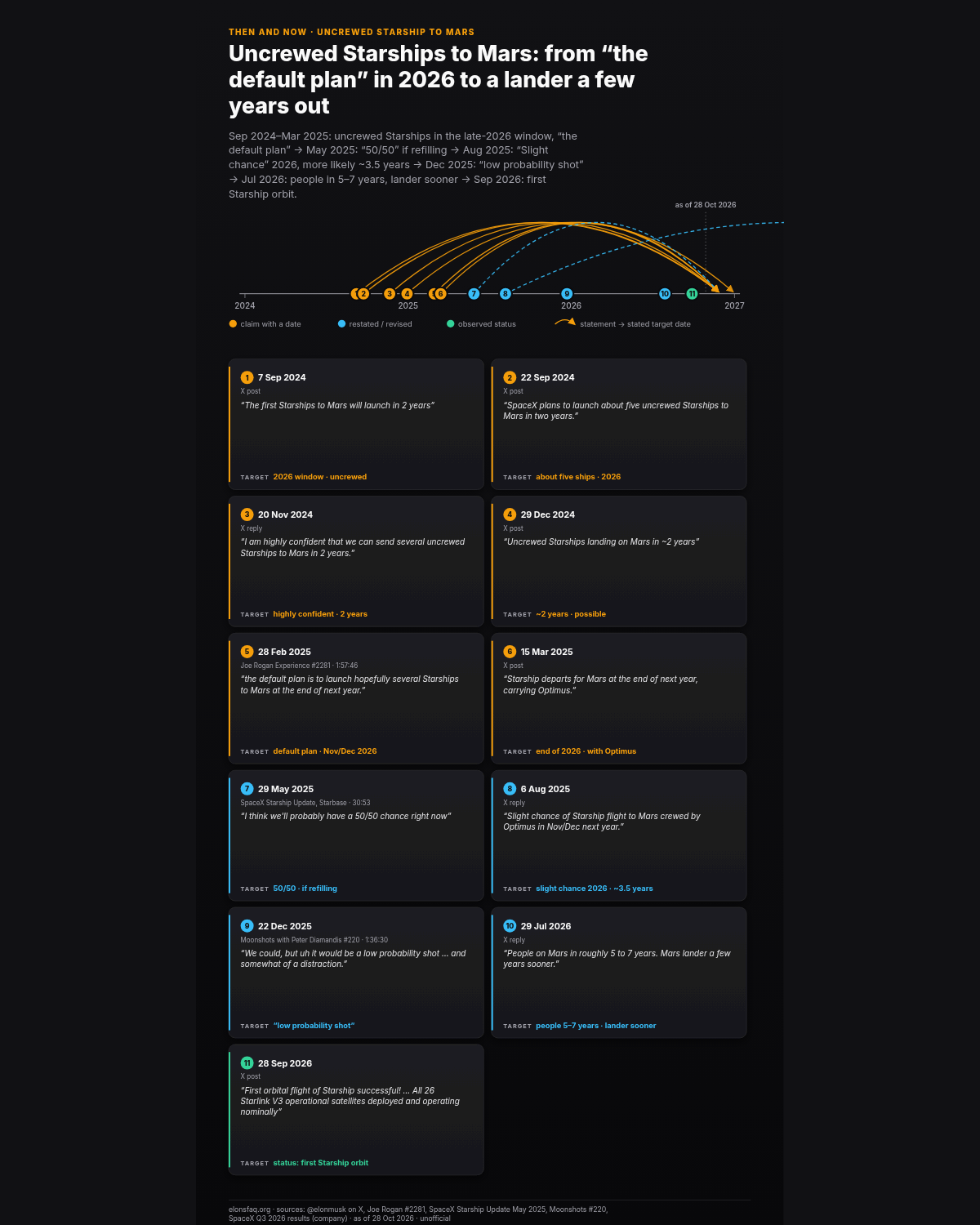
From “the default plan” for the 2026 window to a low-probability shot, with a lander still ahead of crew.
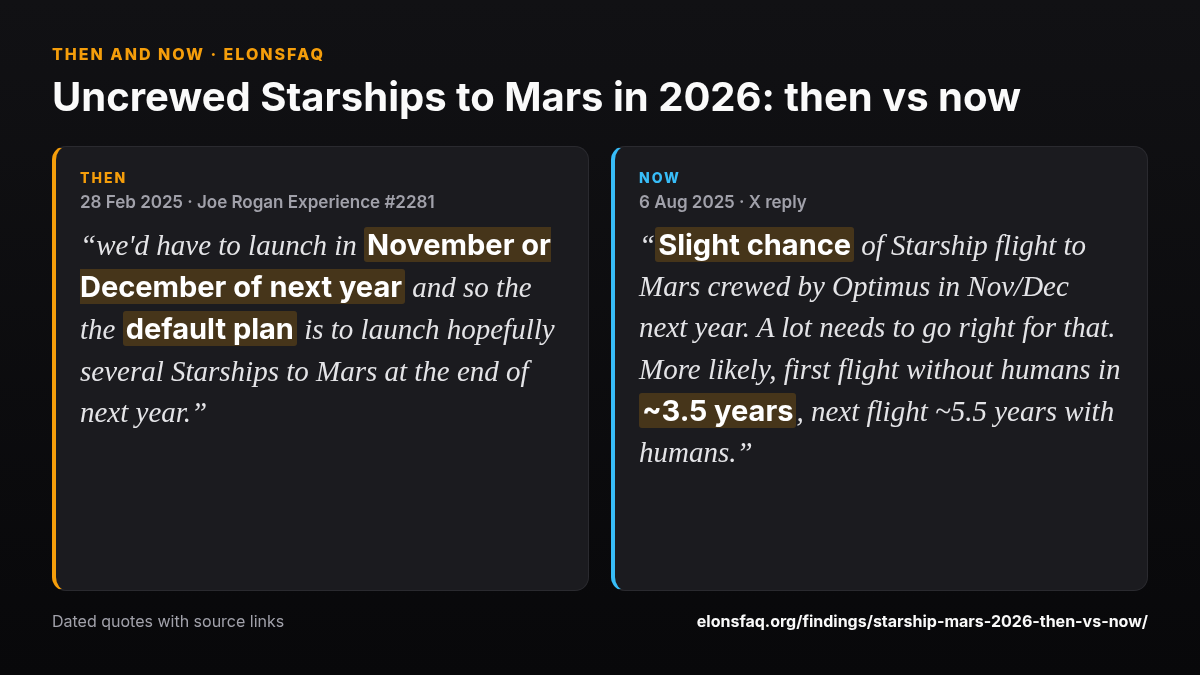
“we'd have to launch in November or December of next year and so the the default plan is to launch hopefully several Starships to Mars at the end of next year.”
“Slight chance of Starship flight to Mars crewed by Optimus in Nov/Dec next year. A lot needs to go right for that. More likely, first flight without humans in ~3.5 years, next flight ~5.5 years with humans.”
What did not change: uncrewed first, then crew if landings go well · the Earth–Mars window every ~26 months · orbital refilling as the gate. ElonsFAQ corpus · verified 2026-10-23 · unofficial.
“The first Starships to Mars will launch in 2 years when the next Earth-Mars transfer window opens. These will be uncrewed to test the reliability of landing intact on Mars. If those landings go well, then the first crewed flights to Mars will be in 4 years.”
“SpaceX plans to launch about five uncrewed Starships to Mars in two years. If those all land safely, then crewed missions are possible in four years. If we encounter challenges, then the crewed missions will be postponed another two years.”
Editorial calendar reading: two years from Sep 2024, tied to the next transfer window, is the late-2026 Earth–Mars opportunity.
20 November 2024, asked how long until the first ship to Mars:
“I am highly confident that we can send several uncrewed Starships to Mars in 2 years. If those ships don’t increment the crater count on Mars, then crewed ships can be sent in 4 years.”
“Uncrewed Starships landing on Mars in ~2 years, perhaps with crewed versions passing near Mars, and crewed Starships heading there in ~4 years are all possible.”
28 February 2025, Joe Rogan Experience #2281, after Joe asked whether the next step was an unmanned voyage to Mars:
“we'd have to launch in November or December of next year and so the the default plan is to launch hopefully several Starships to Mars at the end of next year.”
Editorial calendar reading: “November or December of next year” / “end of next year” from Feb 2025 = November–December 2026.
15 March 2025, on X:
“Starship departs for Mars at the end of next year, carrying Optimus. If those landings go well, then human landings may start as soon as 2029, although 2031 is more likely.”
“I think we'll probably have a 50/50 chance right now because we've got to uh we've got to figure out orbital refilling uh in order to um have enough capability to go to Mars. But if we achieve orbital refilling in time, then we will launch the first uh [uncrewed] uh Starship to Mars at the end of next year.”
The 2026 window is still named; the odds are now “50/50”, and they depend on orbital refilling. Caption “uh” fillers are kept as spoken.
Now
6 August 2025, on X, asked for the timeline:
“Slight chance of Starship flight to Mars crewed by Optimus in Nov/Dec next year. A lot needs to go right for that. More likely, first flight without humans in ~3.5 years, next flight ~5.5 years with humans.”
Editorial calendar reading: from 6 Aug 2025, “Nov/Dec next year” is still Nov/Dec 2026; “~3.5 years” is around early 2029. “crewed by Optimus” means no human crew on board.
22 December 2025 (published 6 January 2026), Moonshots with Peter Diamandis, asked if he was shooting for a Mars shot by the end of next year:
“We could, but uh it would be a low probability shot … and somewhat of a distraction.”
Company figures, not Elon quotes. SpaceX’s Q3 2026 results (20 Oct 2026) call Flight 14 the first orbital Starship flight and the first revenue-generating Starship mission, delivering 26 Starlink V3 satellites. The filing does not describe a Mars-bound Starship. Source: SpaceX Q3 2026 results (PDF).
Status, 28 Oct 2026: the Nov/Dec 2026 window Elon named is still open on the calendar. No uncrewed Starship has left Earth on a trans-Mars trajectory in this record.
What changed
Item
Then (2024–early 2025)
Now (late 2025–2026)
2026 window
“will launch in 2 years”; “the default plan”; “highly confident”
“50/50” if refilling (May 2025); “Slight chance” (Aug 2025); “low probability shot” (Dec 2025)
Uncrewed date if not 2026
the next window, then crew two years later
“More likely … ~3.5 years” (from Aug 2025); lander “a few years sooner” than people in 5–7 years (Jul 2026)
Hardware
Starship still working toward orbit
Flight 14: first Earth orbit and 26 Starlink V3 satellites (Sep 2026)
What did not change
Uncrewed first: test landing intact, then crew if those ships do not add to the crater count.
The clock: Earth and Mars line up about every 26 months; Elon dated the next shot as November or December.
The gate: orbital refilling, named on the May 2025 update as the thing that has to go right.
Neutral conclusion
From Sep 2024 through Mar 2025, Elon dated the first uncrewed Starships to Mars to the late-2026 transfer window — “in 2 years”, “about five” ships, “highly confident”, and on Joe Rogan “the default plan” for November or December. In May 2025 he still named that window, at “50/50” if orbital refilling is ready. In Aug 2025 he wrote “Slight chance” for that window, with an uncrewed flight “more likely” in about 3.5 years. In Dec 2025 he called a 2026 attempt a “low probability shot”. In Jul 2026 he put people on Mars in roughly 5 to 7 years, with a lander a few years sooner. In Sep 2026 Starship reached Earth orbit and deployed Starlink V3. As of 28 Oct 2026 the window he named is still ahead; this record has no trans-Mars Starship. This compares dated wording; it makes no claim about motives.
Scope
Indexed ElonsFAQ corpus (transcripts and X posts); not every Elon Musk interview.
YouTube wording is from automatic captions (ASR); fillers such as “uh” are kept as spoken.
Calendar readings of relative dates (next year, this year, in 2 years) use the statement date.
Latest Tesla and SpaceX operating items are company statements, not Elon quotes, and are labeled.