
Crewed Mars · Finding · Then and now · as of 30 Oct 2026
First humans on Mars: then vs now
Proposition (held fixed): When would humans land on Mars? This page tracks dated Elon estimates for the first crewed Mars landing. Uncrewed Starship-to-Mars dates are on the live mars page.
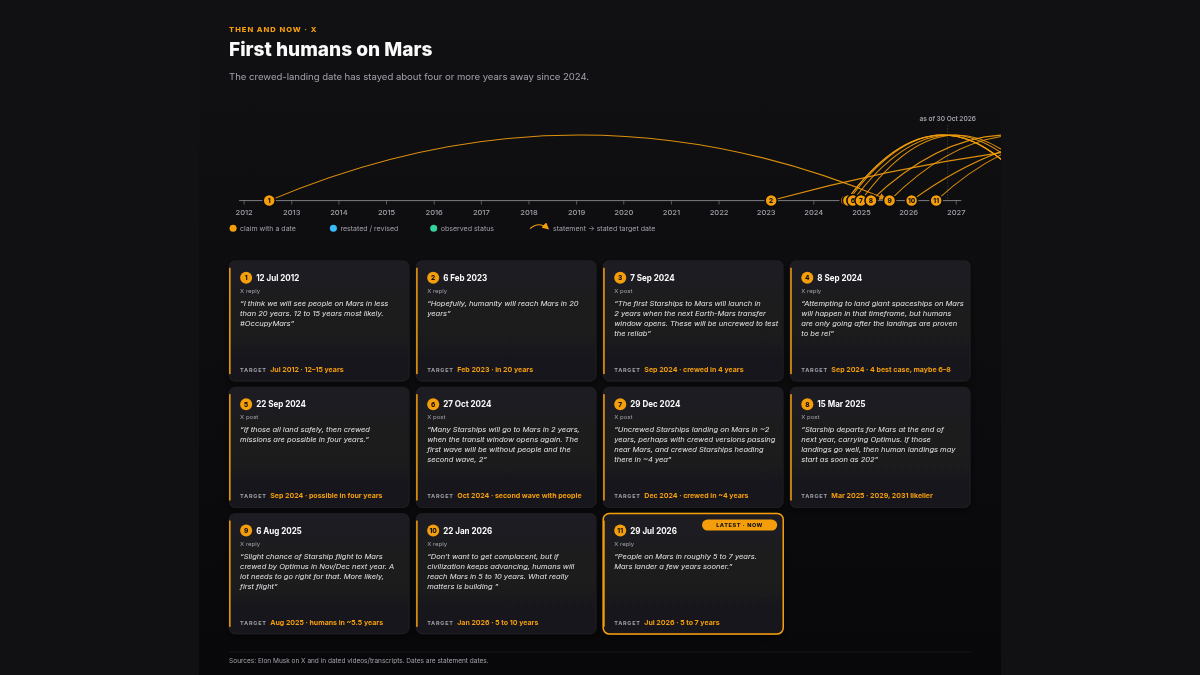
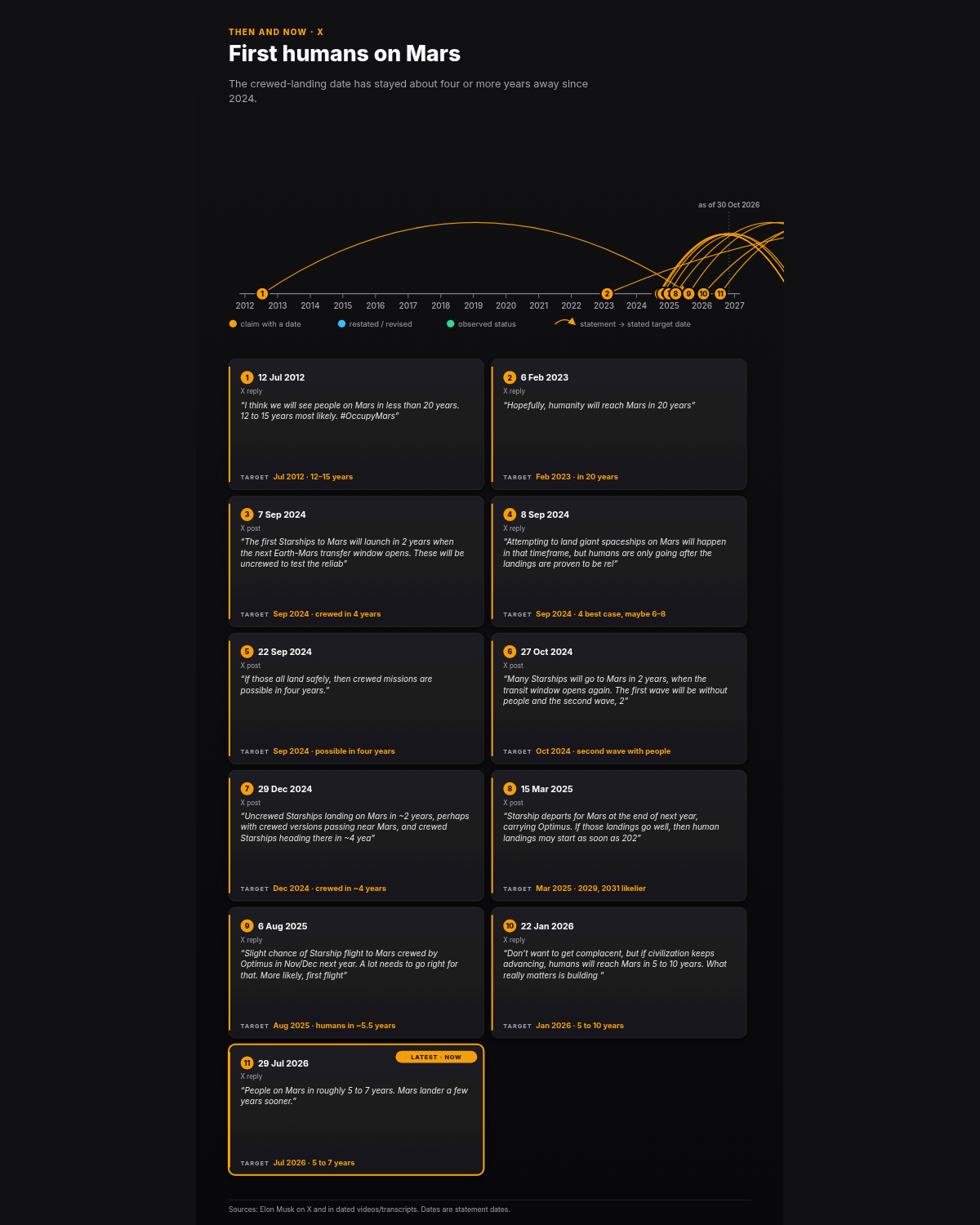
The crewed-landing date has stayed about four or more years away since 2024.
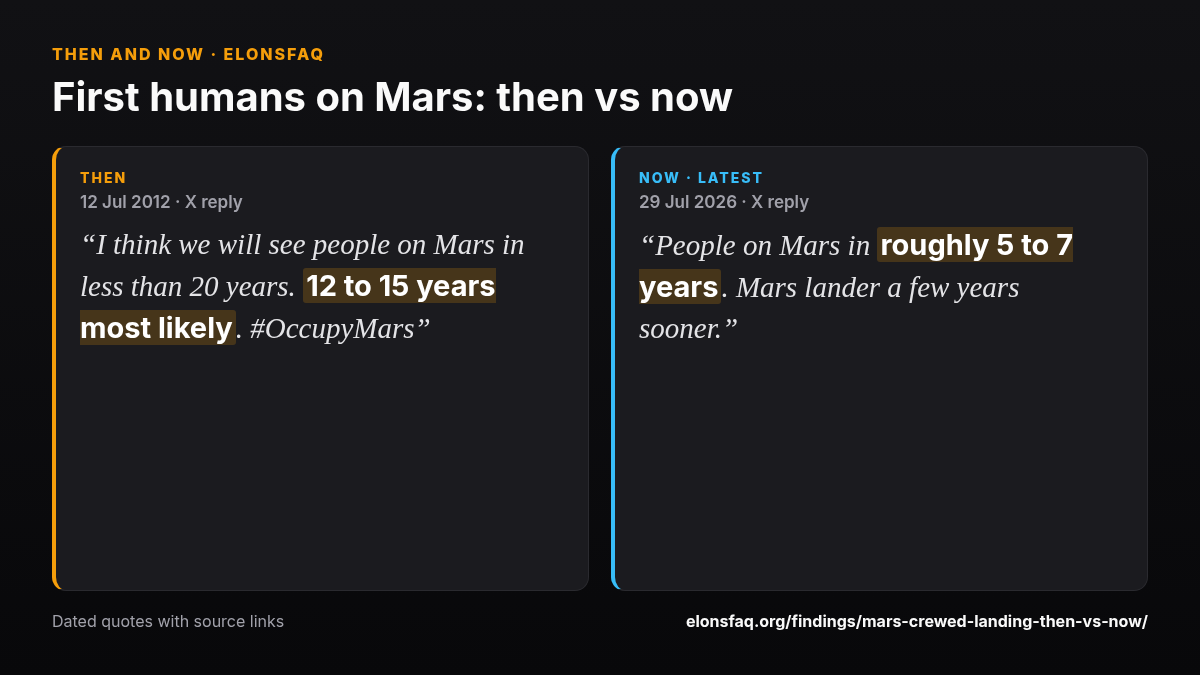
“I think we will see people on Mars in less than 20 years. 12 to 15 years most likely. #OccupyMars”
“People on Mars in roughly 5 to 7 years. Mars lander a few years sooner.”
Mar 2025: “Starship departs for Mars at the end of next year, carrying Optimus. If those landings go well, then human landings may start as soon as 2029, although 2031 is more likely.” 15 Mar 2025 · X post
Jan 2026: “Don’t want to get complacent, but if civilization keeps advancing, humans will reach Mars in 5 to 10 years. What really matters is building a self-sustaining civilization on Mars, which will take another 20 to 30 years.” 22 Jan 2026 · X reply
ElonsFAQ corpus · verified 2026-10-23 · unofficial.
Then
12 July 2012, on X:
“I think we will see people on Mars in less than 20 years. 12 to 15 years most likely. #OccupyMars”
6 February 2023, on X:
“Hopefully, humanity will reach Mars in 20 years”
7 September 2024, on X:
“The first Starships to Mars will launch in 2 years when the next Earth-Mars transfer window opens. These will be uncrewed to test the reliability of landing intact on Mars. If those landings go well, then the first crewed flights to Mars will be in 4 years. Flight rate will grow exponentially from there, with the goal of building a self-sustaining city in about 20 years. Being multiplanetary will vastly increase the probable lifespan of consciousness, as we will no longer have all our eggs, literally and metabolically, on one planet.”
8 September 2024, on X:
“Attempting to land giant spaceships on Mars will happen in that timeframe, but humans are only going after the landings are proven to be reliable. 4 years is best case for humans, might be 6, hopefully not 8.”
22 September 2024, on X:
“If those all land safely, then crewed missions are possible in four years.”
27 October 2024, on X:
“Many Starships will go to Mars in 2 years, when the transit window opens again. The first wave will be without people and the second wave, 26 months later, with people, provided the first wave does not increment the crater count on Mars.”
29 December 2024, on X:
“Uncrewed Starships landing on Mars in ~2 years, perhaps with crewed versions passing near Mars, and crewed Starships heading there in ~4 years are all possible.”
15 March 2025, on X:
“Starship departs for Mars at the end of next year, carrying Optimus. If those landings go well, then human landings may start as soon as 2029, although 2031 is more likely.”
6 August 2025, on X:
“Slight chance of Starship flight to Mars crewed by Optimus in Nov/Dec next year. A lot needs to go right for that. More likely, first flight without humans in ~3.5 years, next flight ~5.5 years with humans. Mars city self-sustaining in 20 to 30 years.”
22 January 2026, on X:
“Don’t want to get complacent, but if civilization keeps advancing, humans will reach Mars in 5 to 10 years. What really matters is building a self-sustaining civilization on Mars, which will take another 20 to 30 years.”
29 July 2026, on X:
“People on Mars in roughly 5 to 7 years. Mars lander a few years sooner.”
Now
What did not change
- uncrewed landings first, then people
- a self-sustaining city as the real goal
Neutral conclusion
In July 2012 Elon said people would most likely be on Mars in 12 to 15 years, around 2024 to 2027. In September 2024 he said crewed flights could follow in four years if uncrewed landings went well, with six or eight years possible. In March 2025 Elon put human landings at 2029 at the earliest and 2031 more likely, and in August 2025 at about 5.5 years. In January 2026 he said 5 to 10 years, and in July 2026 roughly 5 to 7 years. No crewed Mars mission had launched by 30 October 2026.
Scope
- Indexed ElonsFAQ corpus (X posts and transcripts); not every Elon Musk statement.
- X posts verified word for word against the X API on 30 Oct 2026 (author @elonmusk, original posts, not reposts).
- Video wording is from transcripts with timestamps; fillers are kept as spoken.
- Calendar readings of relative dates (next year, this year) use the statement date.