Proposition (held fixed): When would Tesla hit 5,000 Model 3 cars in a week? This page tracks dated Elon wording on that production target. Company unit counts from later years are out of scope except as Elon described them.
end of 20175,000 a week, as dated Jul 2017
end of June 2018“quite likely” a 5,000-car week
Apr 2019“a walk in the park”
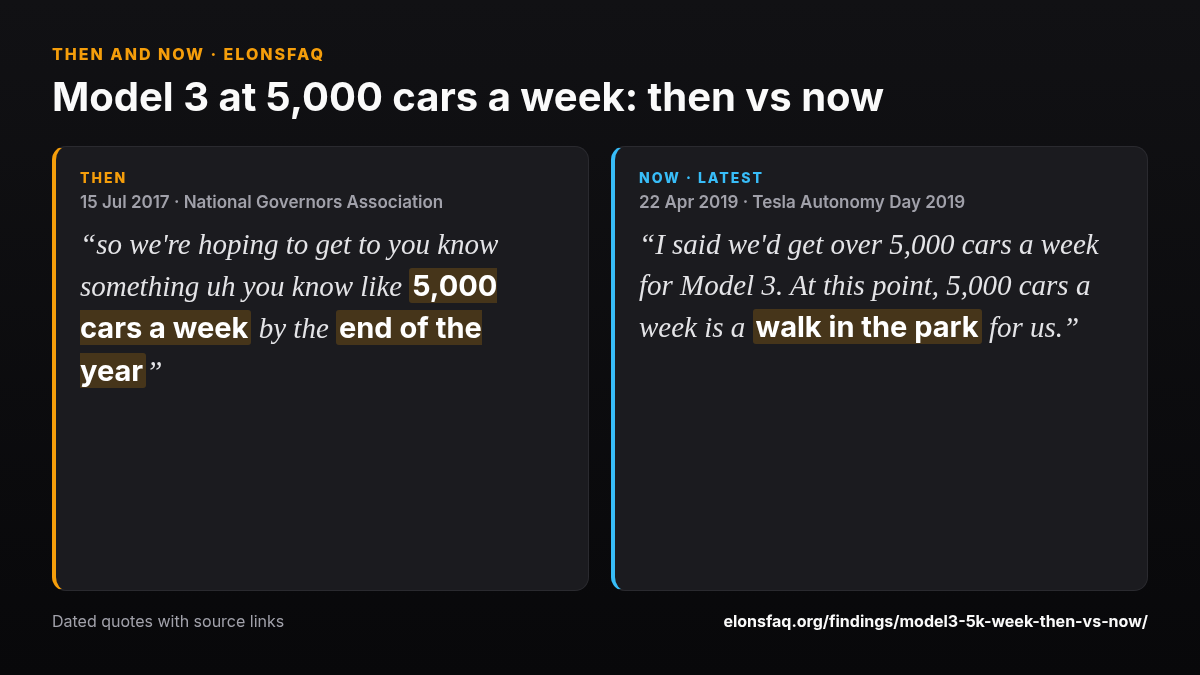
Then vs now · Model 3 5,000 a week
From 5,000 Model 3s a week by the end of 2017, to a 5,000-car week Elon later called a walk in the park.
Then · 15 Jul 2017 · National Governors Association
What did not change: 5,000 a week as the named Model 3 hurdle · Elon treating the ramp as existential. ElonsFAQ corpus · verified 2026-10-23 · unofficial.
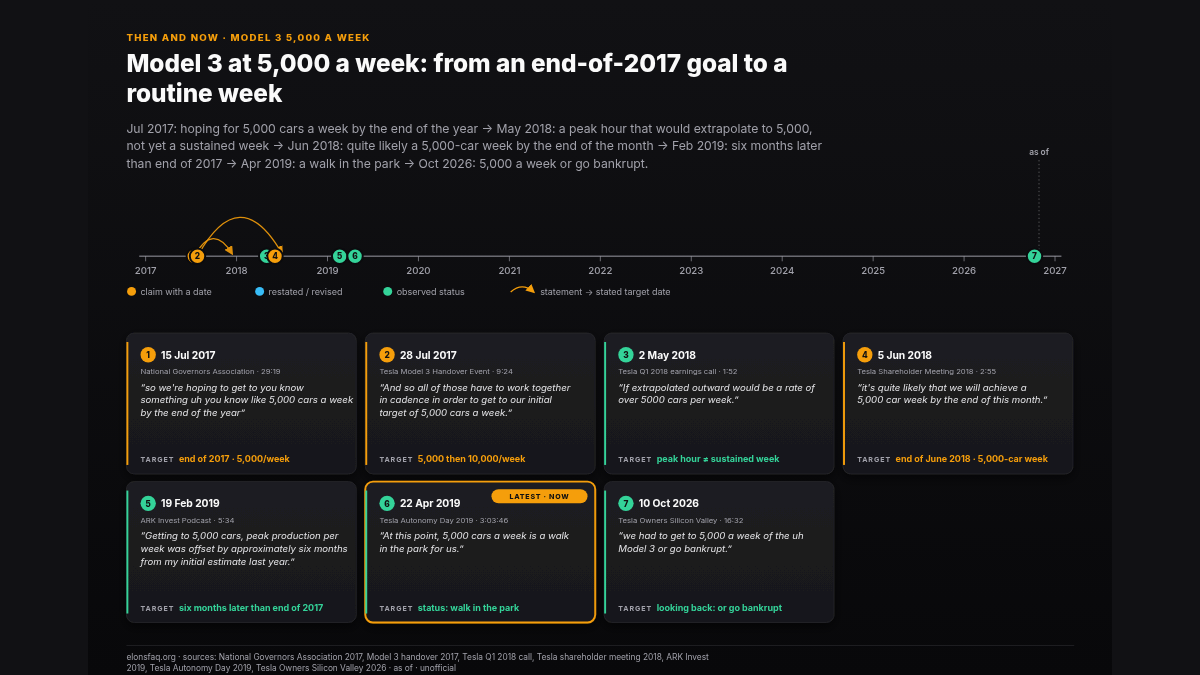
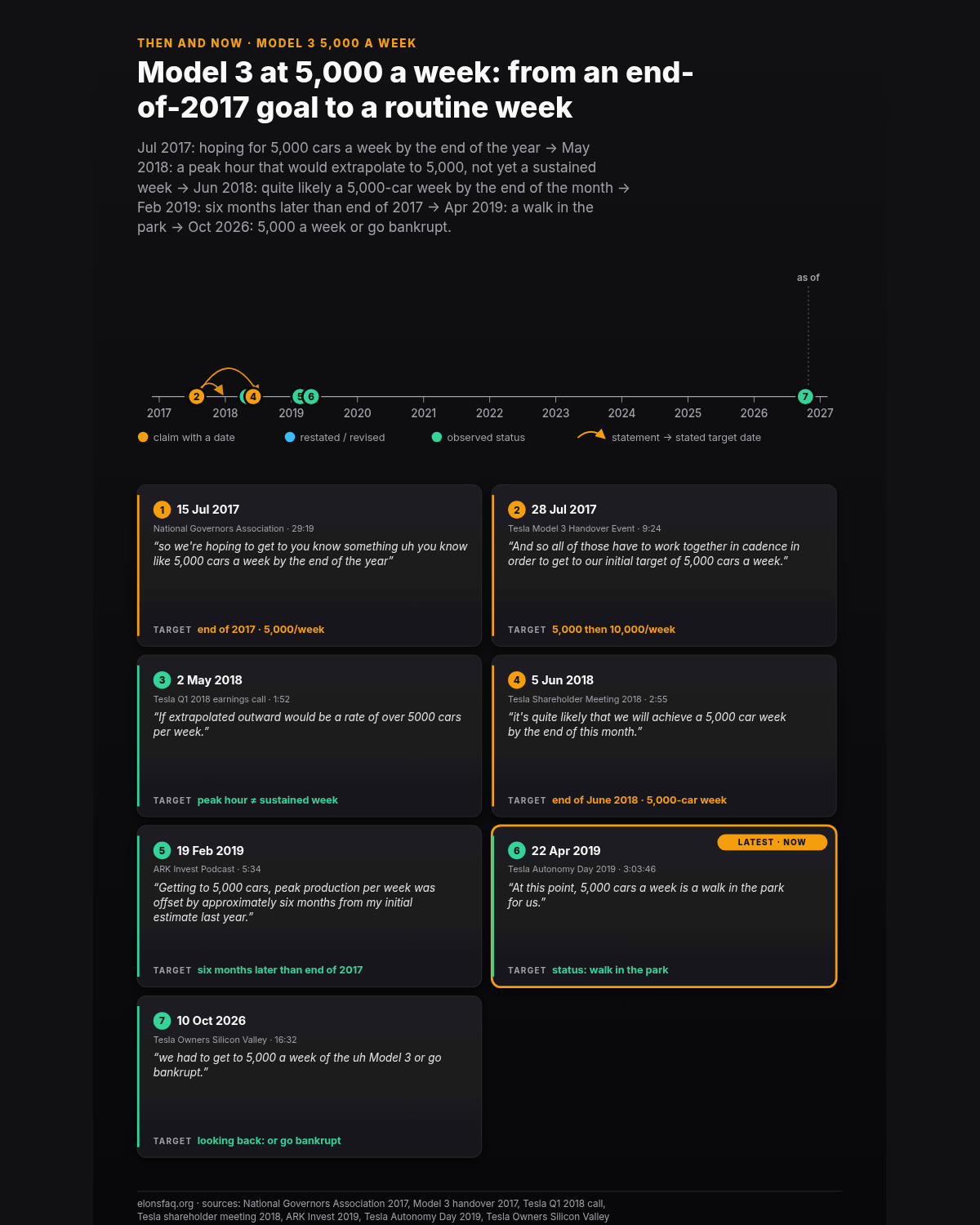
Model 3 at 5,000 a week: from an end- of-2017 goal to a routine week
Jul 2017: hoping for 5,000 cars a week by the end of the year → May 2018: a peak hour that would extrapolate to 5,000, not yet a sustained week → Jun 2018: quite likely a 5,000-car week by the end of the month → Feb 2019: six months later than end of 2017 → Apr 2019: a walk in the park → Oct 2026: 5,000 a week or go bankrupt.
Editorial calendar reading: “the end of the year” from 15 Jul 2017 = end of 2017.
28 July 2017, Model 3 handover:
“And so all of those have to work together in cadence in order to get to our initial target of 5,000 cars a week. And then hopefully by the next year, towards 10,000 cars a week.”
2 May 2018, Tesla Q1 2018 earnings call, on a peak hour rather than a sustained week:
“The thing I'm most excited about is the rapid increase in output we've got just in the last 24 hours at Gigafactory, we managed to achieve a sustained rate of over 3000 packs per day. Sorry, per week and actually reach the peak hour. If extrapolated outward would be a rate of over 5000 cars per week.”
Editorial calendar reading: “the end of this month” from 5 Jun 2018 = end of June 2018.
19 February 2019, ARK Invest podcast, looking back:
“Getting to 5,000 cars, peak production per week was offset by approximately six months from my initial estimate last year. So I thought we'd be there end of 2017.”
hoping by the end of 2017; then 10,000 the next year
quite likely a 5,000-car week by end of June 2018; later described as six months later than end of 2017
How hard
an initial production target
May 2018: a peak hour that would extrapolate to 5,000, not yet the sustained week; Apr 2019: a walk in the park; Oct 2026: do it or go bankrupt
What did not change
The number: 5,000 cars a week as the named Model 3 cadence.
The stakes: Elon kept describing the ramp as the thing Tesla had to clear.
Neutral conclusion
In July 2017 Elon said Tesla was hoping to get to something like 5,000 cars a week by the end of the year, and that 10,000 a week was the hope for the next year. That end-of-2017 week did not arrive. In May 2018 he described a peak hour that would extrapolate to over 5,000 cars a week, and on 5 June 2018 he said a 5,000-car week by the end of that month was quite likely. In February 2019 he said getting to 5,000 peak per week had been offset by about six months from his end-of-2017 estimate. By April 2019 he called 5,000 a week a walk in the park. In October 2026 he said Tesla had had to get to 5,000 a week of the Model 3 or go bankrupt. This compares dated wording; it does not re-audit Tesla’s weekly production tables.
Scope
Indexed ElonsFAQ corpus (transcripts and X posts); not every Elon Musk interview.
YouTube wording is from automatic captions (ASR); fillers such as “uh” are kept as spoken.
A Q2 2018 earnings clip in which Elon says Tesla continued to achieve 5,000 Model 3s per week is held: that video is not in the local faq.json date table.
Parent verifies X posts word for word. This page is video-led.